Showing posts with label D M Lloyd-Jones. Show all posts

Monday, 20 December 2010

1 Kings 17: 1 -7 (part 3)

Here is the third and final part of the study on Elijah at the brook Cherith.

Read the verses here: 1 Kings 17: 1 - 7

Here are the first 2 parts to the study - Part 1 and Part 2

Faith from the Father


Hoeksema (I think) said of faith that ‘our faith was merely us clinging to His faith’. Dr Martyn Lloyd Jones phrased it slightly differently – in the context of our faith he commented that it was “not my grasp of Him but His mighty grasp of me!” He has control, He is sovereign and He is faithful in all.

All His promises will come to pass regardless of our personal faith in Him or even our actions, what God wills happens. We have seen this as we have studied the Exodus and Moses. Moses griped, 'not me Lord?' He made excuses and tried to avoid responsibility, but God’s will was fulfilled. Jonah too. He ran away! But was ultimately delivered to do God’s will.
Time and again in scripture we read of men of God doubting and avoiding God’s direction and we wonder why? Men like Elijah are rare, we don’t hear of his failings and his flaws so much. Moses ducked and dived, Noah got drunk, David was David, even the Apostle Peter was a prejudiced hothead. In Acts we hear about the Apostles arguing and going their separate ways. They were after all just sinful men and as prone as we are to sinful traits, temptations and behaviour.
But here is Elijah – a picture of faith and obedience. But he was still just a man. It stillappears though so very strong. Why?

Elijah clung tighter than most to the Lord’s promises and directions. He felt fear, anxiety, hunger, heat, pain, discomfort (this fear and anxiety is reflected in 1 Kings 19:10 where he says “they seek to take my life away”). He was tempted and attacked by Satan – but his faith stayed strong, he applied his faith in God’s service.

Dr Lloyd Jones used an analogy to explain faith like this: a man and a baby possess strength. The man is stronger, but both possess some element of strength. Yet a baby using every ounce of its strength is stronger than the man who uses none of his at all.

Using and applying one’s faith is what makes the difference. Having faith and keeping it wrapped up and hidden renders it powerless. Straining with every sinew of the faith we do have in His service will affect others.

What helped him to stay so faithful? He was prayerful. He spoke to God, communicated with him. Not going through the motions, but active, live prayer.
I will use an analogy of a boxer to illustrate how faith develops. A boxer has 3 main areas of training – fitness, coaching/padwork, sparring. In the Christian context we can consider this as prayer (our fitness/stamina), padwork and coaching in his word by the Holy Spirit and sparring in witnessing and testifying to the Lord Jesus.

• Fitness (or prayer) - to develop fully this requires time and quality. No corners can be cut. An unfit fighter cannot last the distance. An unpraying Christian has no stamina for the spiritual fight. Elijah was fit – his prayer life and coaching supreme.

• The coaching/Holy Spirit’s guidance – the coach first teaches simple combinations, 2, 4, 6 punch combinations, then parrying, bobbing and weaving and so on. As the fighter’s knowledge and skill increases he becomes more dangerous to his foe with an understanding of the nuances how to fight. A Christian coached in the Word is a well equipped fighter. The coach will gradually and surely impart his knowledge to the fighter, but only as he sees fit.

• Sparring – witnessing and testifying. A fighter doesn’t enter the ring cold. He is well versed and hardened from sparring. He learns how to take blows and continue fighting, sometimes when badly hurt. But it is here that his fitness and his coaching comes through, helping him through the fight. Without testifying to the Lord Jesus a Christian cannot and will not become battle hardened and when he does he runs the risk of getting badly winded, or his spiritual eyes blacked.

As time goes on the understanding and the relationship between the fighter and coach develops too, they are more familiar with each other, the coach knows the fighter's strengths and weaknesses, the fighter may even express lack of confidence in one area. There may even be times when the fighter needs disciplining and reminding of who has control and who taught him what he knows. In this respect Elijah was a world beater, his communication and daily devotions to God would put most to shame. Great also fighters apply themselves, they don’t sit around waiting for the coach to just ‘make them great’. His Sovereignty, our responsibility.

It must be stressed that faith is not a power we possess in ourselves or can generate. Many can view faith like a willpower – ‘if I really, really believe my faith will make this happen’... GOD makes things happen, not our faith. Many think faith is like that TV programme 'Deal or no deal'. That in some way their hope, they're relying on the faith they have in fate will provide for them. Our faith should be that God is right and just and that He has things well in order, that He will always make good on His promises. Our faith itself cannot generate or 'do' anything in itself, it is not like 'the force' in the Star Wars films. This is not to say that faith does not have a powerful impact in our lives, but the power is of God's hand.

Gifts of grace Elijah had in the brook and the ravens’ provision God increases it as He wills. We can ‘work’ at our faith in what we do, and God will bless sincere devotion and obedience. But as with saving faith which justifies, it is a gift of grace. Our responsibility is to do the things which will increase our ‘fitness’ for gracious faith to be increased. We must turn up for training ready to sweat.
Elijah knew (had faith) that God would provide and protect him, but the fears and discomforts remained. Peter Jeffrey tells a story about when he was open air preaching saying if he died that night, he knew where he would be going. Then a heart attack! But he commented in hospital that he was sure of his place in heaven had he passed. He was in discomfort and pain and the experience was surely distressing and frightening, but his faith never left him.

God has promised us over and over again in His word that we are His. Elijah did God’s will regardless of his fears, because it was God’s will. Fear is borne of Satan, he wants us to be distracted and to prevent us from doing the Lord’s work, but we should remember:

Romans 8: 39 “nothing shall separate us from the love of God which is in Christ Jesus”
John 10: 28 – 30 “And I give unto them eternal life; and they shall never perish, neither shall any man pluck them out of my hand. My Father, which gave them me, is greater than all; and no man is able to pluck them out of my Father's hand. I and my Father are one.
Our faith must be that Jesus Christ is our Saviour and that in Him lies the only way we can be justified. In our repentance and His atoning sacrifice we are freed from the bondage of sin and consequently fear too.

He has promised to do this and will always stay perfectly faithful to His promises.

We can cling to His faith and pray that ours increases. We can do as Elijah did, we can be bold and confident, even if our knees knock and our lip quivers, because we “can do all things through Christ which strengtheneth me” Phil 4: 13
We can trust him for our eternal salvation, we can trust him to feed, clothe and house us, we can trust him to put the right words in our mouths and a truer more loyal friend there cannot be. Fall on him in faith, pray and read His promises in this His God breathed infallible word.

We should be as Elijah, we should listen and obey the Lord and if need be suffer discomfort and trials to do his will. The blessings which come from serving him far outweigh any worldly comforts. When we profess the Lord Jesus Christ and our love and service of the Lord God Almighty, he smiles on us, blesses us and sates our every thirst and hunger.

Serve him, love him and your faith will be increased.

Saturday, 8 May 2010

From faith to faith

Romans 1:17 in the KJV says this:


"For therein is the righteousness of God revealed from faith to faith; as it is written, the just shall live by faith."

I have pondered this verse with for some time and was prompted to do so by the book I bought on exegesis. That and my long term bible study on Romans (thus far 10 or 11 months and the first 4 chapters... though I am aware those months could easily be years a la Dr DM Lloyd Jones).
So what conclusion did we come to? I say 'we' as I had some considerable help from Richard B Ramsey, DM Lloyd Jones and Herman Hoeksema... and my Mum. Well initially I made the mistake of looking at the phrase 'from faith to faith' in isolation, without considering the context of the verse. Slightly ironic as verse 16 is one of my favourites!
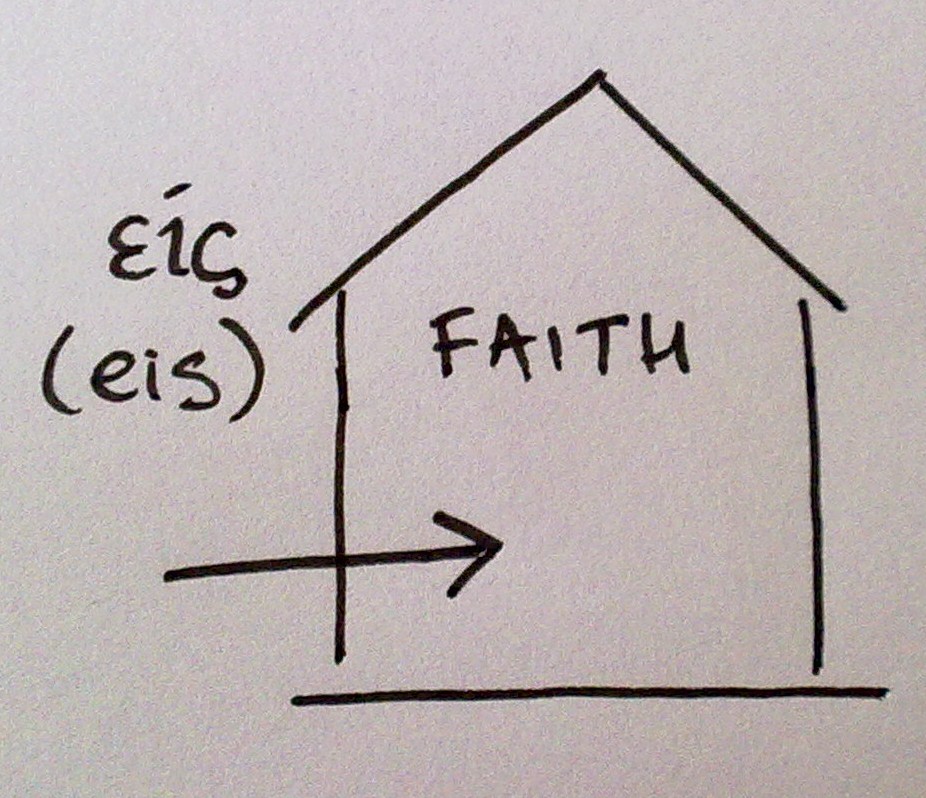
Once I had read about the Greek for 'to faith' and 'from faith' I established a nice mental image of the process of sanctification. It gave me an illustration which since I explained it to my Dad I have been informed it is commonly used... at least I'm on the right track eh? I called it 'Sanctification Street'.
The Greek word in the original text means 'to come out of', rather like coming out of a house. As in my wonderful drawing pictured here. This is 'ek'.
'Eis' on the other hand means 'to enter into'. See the other picture.
The mental picture this gave me was of a street of houses, each fresher, cleaner and more satisfying to live in than the last. With each house representing a new area of faith.
The process of moving from one house to another is sanctification, as we grow and become richer in the faith we move to bigger, better decorated houses. The final move being to Glory, as co-owners of the greatest, most magnificent mansion in eternity. This fitted nicely with the concept of 'ek' and 'eis' in spiritual terms.


The vehicle for moving being the gospel (great mpg and safety rating... no need for airbags, the driver is perfect).

Another analogy I considered was given by RB Ramsey of the gospel bridging 2 islands (or areas) of faith, as you can see here. I like it but 'Sanctification Street' is better I think.


After much consideration... and a comment from my Dad I realised that this was not actually the meaning of the text, but still a worthwhile analogy of growing from faith to faith in our Christian lives. Herman Hoeksema had it nailed in his book 'By Faith Alone' (a must read). It puzzled me at first but after giving it some thought I think this is what he meant:

(Read the verse again first).

'For therein' - meaning the gospel (scriptural and figuratively in the message). '...is the righteousness of God revealed from faith to faith...' I took this to mean that we extract faith from (ek) the gospel and this in turn allows us to further our faith in (eis) the gospel of Jesus Christ.
Was something of a head scratcher at first. But it seems to fit well if you read the verses around it. Any other ideas on this verse will be gladly received. Either way I've spent some time looking at this now and have been blessed by it, I hope it does you too.

Wednesday, 10 March 2010

Propitiation, what a word.

Propitiation... an incredible word if you're a Christian.

"At all costs, whatever it may mean to us, we must hold onto this word. Propitiation through faith in His blood."
D M Lloyd-Jones (Expository notes on Romans)


Wayne Grudem's Systematic Theology words it like this (referencing Romans 3:25 KJV/NKJV/ESV/NASB) - "...tells us that God put forward Christ as a 'propitiation' a word that means "a sacrifice that bears God's wrath to the end and in doing so changes God's wrath toward us into favour."


Herman Hoeksema, when talking of God's wrath in 'Righteous by Faith Alone' explained God's wrath as a 'righteous anger' and perhaps more easily understandable (to me in my paraphrasing) is a 'Holy NO' to sin... God will not have sin in His sight and rejects it utterly with this mighty, unchangeable "NO!"


*disclaimer - my theology is fragile and in its infancy so forgive any errors. The reasons for making the point over the vitality of the word 'propitiation' I hope will become clear.*


The point I am trying to make is that the word propitiation describes how in legal terms God's wrath MUST be appeased and this tariff or sentence that has to be handed out to sin must happen. Without saving grace this death sentence of God's wrath would fall on us sinners. But through delivering Jesus as a propitiatory sacrifice, the sentence, the tariff of the weight of that sin is borne by Jesus. He bears God's wrath, His awesome 'NO' for us.


No other word can substitute for this. Some versions lamely try to substitute it with 'atoning sacrifice' and/or 'expiation', but neither word measures up. Yes there was atonement and yes our sins are 'wiped away' in expiation, but neither is an adequate substitute for propitiation.


The Welsh words 'hwyl' or 'hiraeth' have, apparently, no direct translation into English. Even a sentence to explain them does not adequately describe the depth of feeling and emotion these words supposedly invoke in a true man of the vales. When speaking to a Welsh thoroughbred he will purse his lips and nod vigorously, perhaps even slapping your shoulder and fixing you with a knowing eye when you utter such words.


We frequently use phrases in everyday speech that suggest the lack of effective translation of certain words so you will frequently hear such phrases as 'faux pas' or 'vice versa'. Yes you can describe them, but they don't always do the phrase justice.

In my limited theological knowledge I am already surprised, nay shocked even that such looseness can occur in translating God's word. Propitiation is a key word in the Christian's vocabulary... if not in actual spoken word, then certainly in understanding. How, how, how, how, how it can be omitted completely from the NIV and other versions is a burgeoning mystery to me.


When I read about it and understood it I was awestruck and it made me realise afresh the gravity of exactly what has been done for us at the cross. Remind yourself of what the word means then compare these verses in various versions. It may surprise and even shock you to see the variety of language used for such important sections of scripture.

Romans 3:25
1 John 2:2
1 John 4:10
Hebrews 2:17

As a closing, contrasting comment. I enjoyed singing 'And can it be' in Church recently. My favourite verse being:
.
Long my imprisoned spirit lay
Fast bound in sin and nature's night;
Thine eye diffused a quickening ray,
I woke, the dungeon flamed with light;
My chains fell off, my heart was free,
I rose, went forth, and followed thee.
.
Gotta let rip with those last 2 lines! Amen.